
Banaras Tour Package ,Step into a world where time stands still, where the sacred Ganges flows with stories of millennia, and where spirituality permeates every cobblestone and corner. Banaras, also known as Varanasi or Kashi, is not merely a destination—it’s a transformative journey into the soul of India. At Tripcosmos, we invite you to discover this ancient city through our thoughtfully designed tour packages that reveal the mystical essence of one of the world’s oldest continuously inhabited cities.
The Eternal City: A Living Testament to Faith
Banaras has witnessed the rise and fall of empires, the birth of philosophies, and the unwavering devotion of countless souls for over 3,000 years. This city exists in a realm beyond ordinary time, where the boundaries between the material and spiritual worlds blur into something indefinably beautiful. Walking through its labyrinthine alleys, you’ll encounter scenes that haven’t changed in centuries—priests chanting ancient mantras, artisans weaving golden silk, and pilgrims seeking salvation in the holy waters of Mother Ganga.
Banaras Tour Package , The ghats of Banaras stretch like a magnificent amphitheater along the river’s western bank, each step bearing witness to prayers, celebrations, births, and deaths. Here, life is lived in its rawest, most honest form. The city makes no apologies for its chaos, its intensity, or its unfiltered spirituality. Instead, it embraces you with all its contradictions and invites you to look beyond the surface into something profoundly meaningful.
The Sacred Ghats: Where Heaven Meets Earth
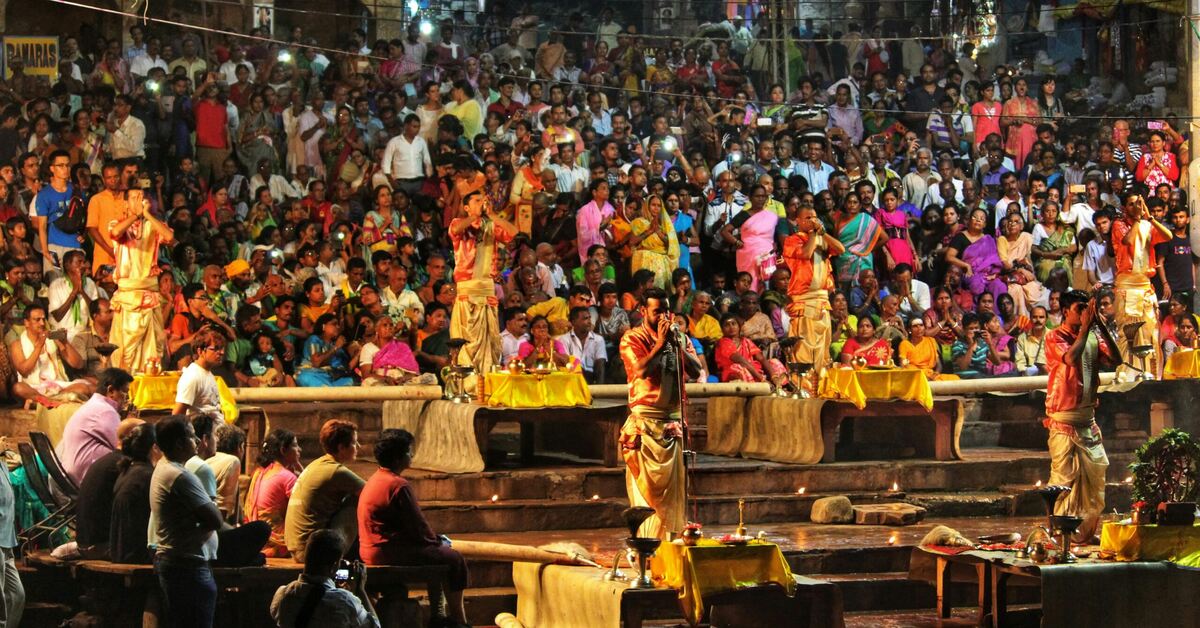
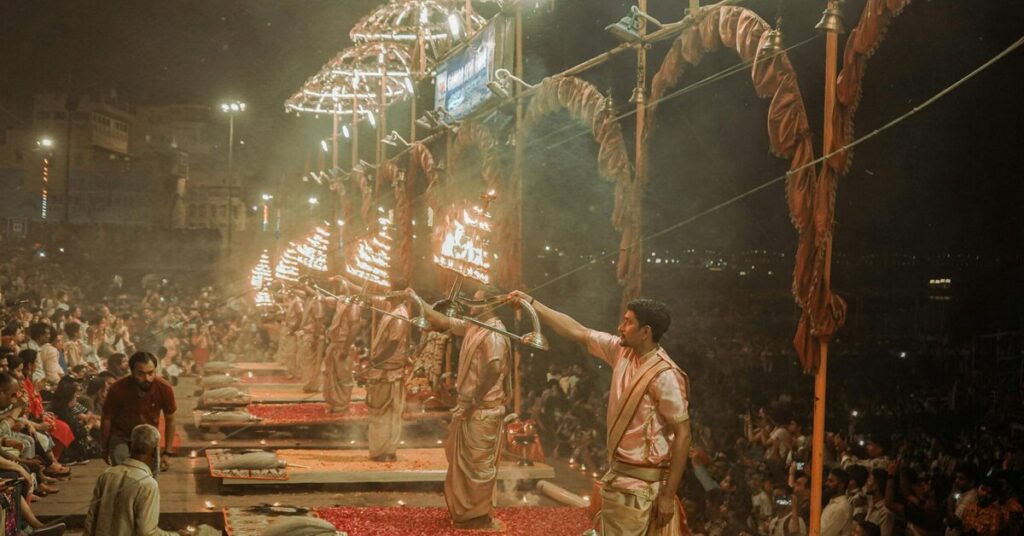
Banaras boasts 88 ghats, each with its own character, history, and significance. Our tour package ensures you experience the most iconic ones, starting with Dashashwamedh Ghat, the spiritual epicenter of the city. Every evening, as the sun begins its descent, this ghat transforms into a celestial stage for the Ganga Aarti—a magnificent ceremony that captivates thousands of spectators.
Picture this scene: Seven young priests, clad in saffron robes, stand in perfect synchronization on raised platforms. As the first notes of devotional music fill the air, they lift massive multi-tiered brass lamps adorned with flowers and bells. The choreography is mesmerizing—the lamps trace patterns against the darkening sky, their flames reflecting in the river like liquid gold. Conch shells blow, bells ring, and the collective chanting creates a sound that seems to resonate from the earth itself. The air becomes thick with incense, the energy palpable, as devotees release small leaf boats with flickering diyas onto the river’s surface. These tiny flames drift downstream like prayers made visible, carrying hopes and wishes into the embrace of the sacred Ganges.
Our morning boat rides offer an entirely different perspective. As dawn breaks over the eastern horizon, the city awakens in a symphony of spiritual practice. From your boat, you’ll witness yogis performing surya namaskar on the ghats, elderly women in colorful saris taking their ritualistic dips, children laughing as they splash in the shallows, and sadhus (holy men) with ash-smeared bodies sitting in meditation. Temples emerge from the morning mist, their spires catching the first rays of sunlight. The sound of temple bells mingles with Sanskrit chants and the gentle lapping of oars against water, creating a soundscape that feels timeless.
Assi Ghat, located at the confluence of the Assi and Ganges rivers, provides a more intimate experience. This is where you’ll find the city’s intellectual and artistic soul—musicians practicing ragas, painters capturing the river’s moods on canvas, and philosophers engaged in animated discussions over cups of chai. The morning Subah-e-Banaras program here showcases classical music performances as the sun rises, an experience that connects you to centuries of cultural heritage.
Manikarnika Ghat, the main cremation ground, offers perhaps the most profound experience in Banaras. This is where the Hindu belief in the cycle of life and death becomes tangible reality. Funeral pyres burn around the clock, as families bid farewell to their loved ones in the belief that cremation here breaks the cycle of rebirth and grants moksha (liberation). While it may seem confronting to witness, there’s a strange peace in observing how naturally death is integrated into the rhythm of life here. The smoke rising from the pyres is said to carry souls to their next journey, and the priests who maintain the eternal flames claim their lineage goes back 3,500 years.
Temples: Architecture of Devotion
The Kashi Vishwanath Temple stands as Banaras’s spiritual crown jewel. Dedicated to Lord Shiva in his manifestation as Vishwanath (Lord of the Universe), this temple has been destroyed and rebuilt multiple times through history, yet it remains one of Hinduism’s most sacred shrines. The current structure, with its gleaming golden spire weighing over 800 kilograms, was built in 1780 by Maharani Ahilya Bai Holkar of Indore. The gold plating on the towers was added by Maharaja Ranjit Singh of Punjab four decades later.
During our guided visit, you’ll navigate through the narrow lanes of Vishwanath Gali, where the energy intensifies with each step closer to the temple. The air fills with the scent of jasmine and marigold garlands, the sound of bells, and the chanting of “Har Har Mahadev.” Inside, devotees line up for darshan (sacred viewing) of the Shiva lingam, the temple’s central deity. Even for those not religiously inclined, the atmosphere of pure devotion is deeply moving.
The Sankat Mochan Hanuman Temple, established by the revered saint Tulsidas in the 16th century, offers a different energy—one of strength and protection. Here, devotees believe that Lord Hanuman removes all troubles and obstacles. Tuesday and Saturday see particularly large crowds, as these days are considered especially auspicious for worshipping Hanuman. The temple courtyard often hosts classical music performances, continuing a tradition that honors Tulsidas’s contribution to devotional literature.
The Durga Temple, recognizable by its distinctive red ochre color, stands in a peaceful area away from the main ghats. Legend holds that the idol of Goddess Durga wasn’t installed here but appeared on its own. The temple’s architectural style showcases North Indian Nagara architecture, and its multiple spires create a striking silhouette. The temple tank, inhabited by numerous monkeys, adds to the sacred atmosphere.
Sarnath: Where the Buddha Spoke
Just ten kilometers from Banaras lies Sarnath, one of Buddhism’s four most sacred sites. After attaining enlightenment in Bodh Gaya, Lord Buddha came to Sarnath’s Deer Park and delivered his first sermon, setting in motion the wheel of Dharma. This event, known as the Dhammacakkappavattana Sutta, laid the foundation for Buddhist philosophy and marked the beginning of the Buddha’s teaching mission.
The Dhamek Stupa, standing 43 meters tall, dominates the landscape with its impressive cylindrical structure. Built during the Gupta period, it marks the exact spot where Buddha gave his first sermon. The intricate geometric and floral patterns carved into the stone still visible after 1,500 years showcase the artistic brilliance of ancient Indian craftsmen. Walking around the stupa in clockwise meditation (parikrama), you’ll see Buddhist pilgrims from Thailand, Tibet, Japan, and Sri Lanka, all drawn to this place where their spiritual tradition began.
The Sarnath Archaeological Museum houses one of India’s national treasures—the Lion Capital of Ashoka. This polished sandstone sculpture, which now forms India’s national emblem, exemplifies the sophisticated artistry of the Mauryan period. The museum’s collection includes hundreds of Buddha images in various mudras (hand gestures), each telling a different aspect of Buddhist teachings. The serene faces and graceful poses of these sculptures create an atmosphere of profound peace.
The peaceful gardens surrounding the ruins provide space for contemplation. Bodhi trees planted by various Buddhist countries create shaded walkways where monks in maroon and saffron robes practice walking meditation. Modern monasteries built by Buddhist communities from around the world—Tibetan, Thai, Japanese, and Sri Lankan—dot the landscape, each reflecting their unique architectural traditions while honoring the universal message of Buddha.
Cultural Immersion: The Fabric of Banaras
Banaras has been a center of learning, music, and arts for centuries. The city’s cultural heritage runs as deep as its spiritual traditions, and our tour package ensures you experience both dimensions. The Banarasi silk weaving tradition dates back to the Mughal era when Persian artisans settled here and created the intricate brocade techniques still used today. Visiting a traditional weaving center reveals the painstaking artistry behind each saree—some pieces take months to complete, with weavers working on handlooms that have been passed down through generations.
The narrow lanes of the old city form a maze that seems designed to lose the logical mind and awaken the senses. Vishwanath Gali, leading to the golden temple, throbs with commercial and religious energy. Shops overflow with brass idols, rudraksha beads, religious texts, and devotional items. The famous Thatheri Bazaar specializes in brass and copper utensils—walking through it creates a symphony of metallic sounds as artisans hammer, shape, and polish their wares using techniques unchanged for centuries.
Banaras has nurtured some of India’s greatest classical musicians, and music seems to flow through the city’s veins. The gharana (school) of Hindustani classical music that originated here emphasizes complex rhythmic patterns and improvisational brilliance. If your visit coincides with the evening, you might catch impromptu performances at temples or ghats, where young students practice under the guidance of their gurus, continuing a tradition of oral musical transmission that spans centuries.
A Gastronomic Journey
Banarasi cuisine reflects the city’s cultural synthesis—influenced by Mughal, Bengali, and traditional North Indian flavors. Our tour includes culinary experiences that go beyond mere meals to become cultural education. Start your morning with kachori sabzi at a local eatery where locals have been breaking their fast for decades. These deep-fried bread puffs filled with spiced lentils, served with potato curry, exemplify comfort food elevated to an art form.
The legendary Blue Lassi shop, tucked in a tiny space near Dashashwamedh Ghat, serves lassi so thick you could almost stand a spoon in it. The walls plastered with business cards and photographs from visitors worldwide testify to its cult status. Choose from exotic flavors like apple, banana, or pomegranate, or stick with the classic sweet or salted versions. Each lassi comes topped with malai (cream) so rich it feels decadent.
No visit to Banaras completes without trying paan from one of the legendary paan shops. Keshav Paan Bhandar and Tambulam Paan Corner create these betel leaf packages with dozens of ingredients—rose petal jam, sweetened coconut, candied fruits, and special spices. The ritual of eating paan—the explosion of flavors, the slow chewing, the inevitable red-stained lips—is as much a part of Banarasi culture as the Ganga Aarti.
Evening snacks might include chaat at Deena Chat Bhandar, where the tamatar (tomato) chaat offers a unique twist on street food. Or sample the malaiyyo, a delicate milk-based sweet available only in winter months, prepared by whisking milk froth for hours until it achieves an impossibly light texture. These culinary adventures connect you to the city’s rhythm and traditions in the most delicious way possible.
Why Choose Tripcosmos?
Our Banaras tour packages are crafted with intimate knowledge of the city and deep respect for its spiritual significance. We don’t just show you the sights; we help you understand the stories, traditions, and beliefs that make them meaningful. Our local guides are not merely information sources but storytellers who bring history alive, philosophers who can explain complex spiritual concepts in accessible terms, and friends who ensure your comfort and safety throughout the journey.
We understand that Banaras can be overwhelming—the sensory intensity, the crowds, the confrontation with mortality at the cremation ghats. Our pacing allows for both immersive experiences and quiet moments of reflection. We balance structure with flexibility, ensuring you see the must-visit sites while leaving room for spontaneous discoveries that often become the most memorable parts of any journey.
Your accommodation options range from heritage properties overlooking the ghats, where you can watch the river from your balcony, to comfortable modern hotels with all amenities. We handle all logistics—transportation, entry tickets, boat bookings—allowing you to focus entirely on the experience rather than the arrangements.
Frequently Asked Questions
What is the best time to visit Banaras?
The optimal period for visiting Banaras spans from October through March, when temperatures remain pleasant for extensive walking and sightseeing. October and November are particularly enchanting as they coincide with major festivals—Diwali transforms the ghats into a cascade of lights, while Dev Deepavali, celebrated fifteen days later on Kartik Purnima, sees thousands of earthen lamps illuminating every ghat in a breathtaking display. Winter months (December-January) offer clear skies perfect for photography and comfortable temperatures around 15-20°C during the day. The summer months (April-June) bring extreme heat exceeding 45°C, making outdoor activities challenging. Monsoon season (July-September) sees heavy rainfall and rising river levels, though some travelers find beauty in the dramatic skies and fewer crowds. However, navigating the wet, slippery ghat steps requires extra caution during this period.
How many days should I spend in Banaras?
We recommend a minimum of three days and two nights to meaningfully experience Banaras. This duration allows you to witness both sunrise and sunset on the Ganges, attend the evening Ganga Aarti at different ghats, explore the old city’s labyrinthine lanes without rushing, visit the major temples, take an excursion to Sarnath, and still have time to simply sit by the river and absorb the atmosphere. Day one typically covers the main ghats, temples, and evening aarti. Day two includes a sunrise boat ride, Sarnath visit, and exploring the cultural aspects like silk weaving and local markets. Day three allows for deeper exploration of areas that particularly resonated with you, trying local cuisine, and perhaps attending a classical music performance. However, many visitors find that Banaras reveals itself slowly—five to seven days provide a more relaxed pace and opportunities for unexpected discoveries. We offer flexible packages from two days to a week, customizable based on your schedule and interests.
Is it safe to take a dip in the Ganges, and what about the water quality?
This is perhaps the most frequently asked and most complex question about Banaras. The Ganges holds immense spiritual significance for Hindus, who believe bathing in it cleanses sins and brings spiritual purification. However, environmental concerns about water quality are valid and well-documented. The river receives sewage and industrial discharge, and while religious faith remains unshaken, we must acknowledge scientific realities. For spiritual seekers, participating in the ritual holds meaning beyond physical cleanliness. If you choose to take a dip for the cultural and spiritual experience, we recommend doing so at Assi Ghat or other less crowded locations during early morning when the water is relatively cleaner, keeping your mouth closed, and showering immediately afterward. Avoid submerging if you have open cuts or wounds. Many visitors choose instead to participate by releasing flower offerings or simply touching the water to their forehead as a symbolic gesture. The Namami Gange initiative is working on river cleaning, but transformation takes time. Our guides provide honest assessments and can suggest the safest ways to participate in river rituals if you wish to do so.
What should I wear in Banaras, especially when visiting temples and ghats?
Banaras is a conservative religious city, and dressing modestly shows respect for local customs and ensures comfortable interaction with the community. For women, we strongly recommend wearing traditional Indian attire like salwar kameez, long skirts paired with tops that cover shoulders, or kurtas with leggings. Sarees are always appropriate and help you blend into the cultural landscape. Avoid shorts, short skirts, sleeveless tops, or clothing with plunging necklines. A dupatta (scarf) is useful for covering shoulders or head when entering temples. For men, full-length trousers and shirts (short or long-sleeved) work well. Avoid shorts and sleeveless shirts when visiting religious sites. Comfortable walking shoes are essential—you’ll navigate uneven surfaces, steep ghat steps, and narrow lanes. However, most temples require removing footwear before entering, so wear shoes that slip on and off easily. Consider carrying socks as temple and ghat floors can be hot during midday or cold during winter mornings. The ghats have steps that can be wet or slippery, so avoid flip-flops in favor of sandals with better grip or closed shoes. Bring a small bag for storing shoes while inside temples. During summer, light cotton clothing in breathable fabrics makes the heat manageable, while winter evenings (December-January) can be quite cold, requiring layers, shawls, or light jackets.
Can I customize the tour package according to my interests?
Absolutely, customization is one of Tripcosmos’s specialties. We recognize that every traveler comes to Banaras with different expectations and interests. Spiritual seekers might want extended time for meditation, temple visits, or meetings with learned priests who can explain Hindu philosophy. Photography enthusiasts might request specific timing at ghats to capture the best light or access to vantage points that showcase the city’s visual drama. Culture and history lovers might prefer additional time at museums, classical music performances, or deeper exploration of the city’s architectural heritage. Yoga practitioners can include morning yoga sessions by the river with experienced instructors. Food lovers might want expanded culinary experiences, including cooking classes to learn traditional recipes or comprehensive street food tours. We can adjust accommodation types—from budget guesthouses to luxury heritage hotels—and the pace of the itinerary. Some prefer packed schedules maximizing sites covered, while others want leisurely days with ample downtime for personal reflection and wandering. If you’re combining Banaras with other destinations like Allahabad, team, and we’ll design an itinerary that feels personally crafted rather than generic. The initial consultation is complimentary, and we refine the plan until it perfectly matches your vision for the journey.
Begin Your Spiritual Journey
Banaras is not a place you simply visit; it’s an experience that visits you, remaining in your consciousness long after you’ve left its ghats. Whether you seek spiritual awakening, cultural enrichment, historical understanding, or simply the adventure of encountering one of the world’s most extraordinary cities, our Banaras tour packages provide the structure, support, and local expertise to make your journey meaningful and memorable.
Contact Tripcosmos today to start planning your Banaras adventure. Let us handle the details while you open yourself to the transformation that this ancient city offers to every soul willing to embrace its intensity, wisdom, and timeless beauty.
Tripcosmos: Turning travel dreams into reality, one sacred step at a time.





[…] the journey. For those seeking comprehensive travel solutions beyond just transportation, our Varanasi Tour Packages integrate 12-seater tempo traveller services with accommodation, meals, and guided sightseeing, […]